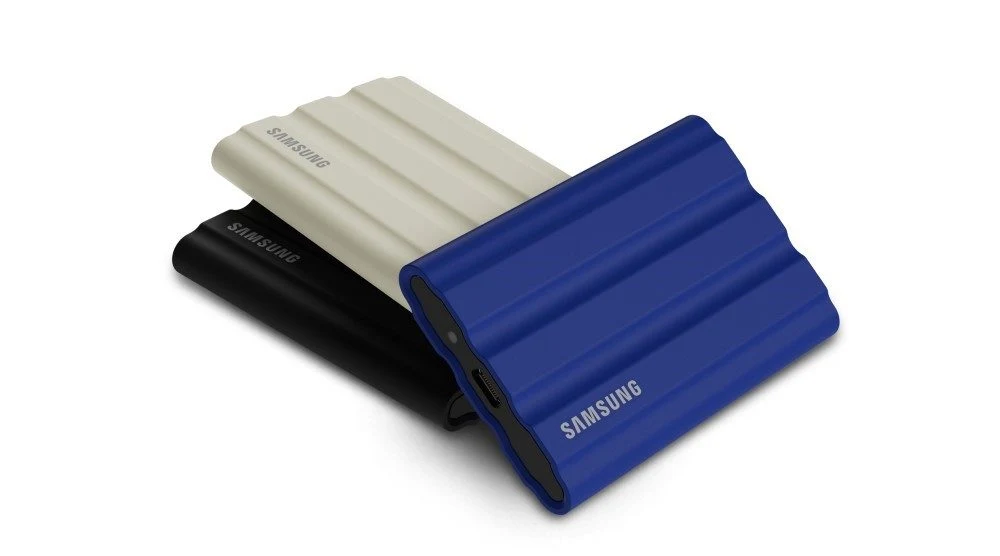
We recommend the T7 Shield for people who want portable storage with added protection for everyday travel. Samsung specifies USB 3.2 Gen 2, sequential reads of up to 1,050 MB/s, and IP65 dust and water resistance under controlled test conditions. It is a practical file-carrying tool; a separate backup remains essential.
What makes it worth a look
- A dust- and water-resistant enclosure is useful for storage that travels.
- USB-C and a 10 Gbps interface are a practical pairing for compatible computers.
- A dedicated portable drive keeps large working files separate from internal storage.
A practical kind of portability
Portable storage has a straightforward job: move your files without turning the journey into a project. The T7 Shield adds a more protective enclosure to that idea. We see the strongest fit for a working drive that moves between a home desk, an office, and a bag.
Your connection sets the pace
The rated speed is not a guarantee that every computer will reach it. A slower USB port or cable can limit transfers before the SSD itself becomes the bottleneck. Check the port specification on your computer and avoid choosing a drive by connector shape alone.
Protection has boundaries
Samsung publishes the IP65 rating under controlled test conditions. That is useful context for dust and water exposure, but it should not become a reason to deliberately expose the drive to either. Keep the connector clean and dry, and treat important files as something worth duplicating.
Choose capacity around the files you keep
Look at your current working folders and leave room for growth. A drive that is nearly full from the first week is a false economy. If you only need to archive files at a desk, compare the cost of a larger desktop storage option before paying for portability.
Useful tradeoffs
- IP65 does not mean the drive is suitable for submersion.
- Actual transfers depend on the port, cable, file sizes, and workload.
- Rugged hardware cannot replace a second copy of important files.
The details that matter
- Interface
- USB 3.2 Gen 2
- Rated read speed
- Up to 1,050 MB/s
- Rated write speed
- Up to 1,000 MB/s
- Protection
- IP65, under manufacturer test conditions
- Connection
- USB-C
- Model
- T7 Shield; capacity varies by listing
Specifications reflect the manufacturer’s published information. Performance figures are manufacturer ratings, not TechGrounded measurements.
Before you choose
Read our storage buying guide → for the questions that matter beyond the spec sheet.
Your questions, answered.
Is the Samsung T7 Shield waterproof?
It is rated IP65 for dust and water resistance under manufacturer test conditions. That does not mean it is designed for submersion.
Will the T7 Shield reach its advertised speed on every computer?
No. Samsung rates sequential reads at up to 1,050 MB/s and writes at up to 1,000 MB/s. The host port, cable, files, and workload affect actual transfers.
Can a T7 Shield be my only backup?
We recommend keeping another independent copy of important files. A portable drive can be lost, damaged, or accidentally erased.
Source checked October 19, 2026. Samsung specifications and test conditions ↗ Photography: Samsung. Our editorial standards.
We may earn a commission from qualifying purchases through affiliate links. Commercial relationships do not determine our conclusions.